Agentic MDLC Workflow
Human-centered workflow: who directs, what agents do, what becomes an artifact, where control gates sit.
Diagram
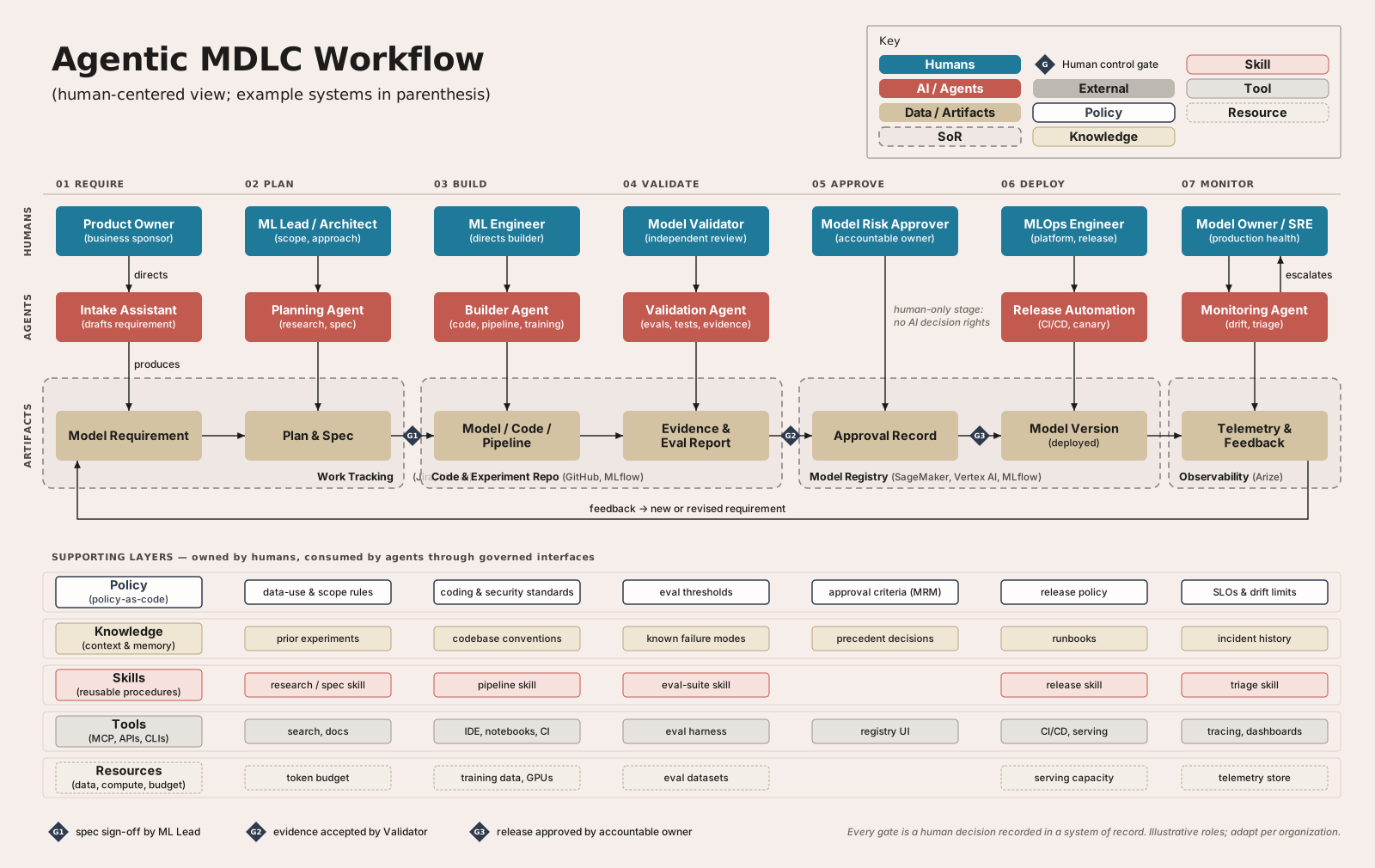
How to read it
- Columns are lifecycle stages. Rows are humans, agents and artifacts.
- Vertical arrows: a human directs an agent; the agent produces an artifact.
- The horizontal artifact flow carries work forward; diamonds (G1–G3) are human control gates.
- Stage 05 has no agent, on purpose: approval is human-only.
- Bands at the bottom show which policy, knowledge, skills, tools and resources each stage uses.
Responsibility matrix
| Stage | Human role | Agent | Artifact | Gate |
|---|---|---|---|---|
| Require | Product Owner (A) | Intake Assistant (R) | Model Requirement | — |
| Plan | ML Lead (A) | Planning Agent (R) | Plan & Spec | G1 spec sign-off |
| Build | ML Engineer (A) | Builder Agent (R) | Model / Code / Pipeline | — |
| Validate | Model Validator (A) | Validation Agent (R) | Evidence & Eval Report | G2 evidence accepted |
| Approve | Model Risk Approver (A, R) | none | Approval Record | G3 release approval |
| Deploy | MLOps Engineer (A) | Release Automation (R) | Model Version | — |
| Monitor | Model Owner / SRE (A) | Monitoring Agent (R) | Telemetry & Feedback | — |
Interpretation
Once agents do the work in most stages, the human job becomes setting direction at the start of a stage and accepting evidence at the end. Each gate needs evidence an agent can produce and a human can review fast.
Should G2 (evidence acceptance) ever be delegated to a second, independent validation agent for low-risk models?